






The New Reality of Logistics: Real-Time or Risk Falling Behind
Logistics today is no longer just about moving goods—it’s about moving data instantly. With over 70% of logistics leaders prioritizing real-time visibility, the pressure to modernize legacy systems has never been higher.
At the same time, companies adopting API-led integration are seeing up to 50% reduction in integration costs and 2–3x faster partner onboarding—making APIs not just a technical upgrade, but a business advantage.
For PGL, this shift became critical as operations scaled and customer expectations evolved.
About PGL
PGL is a logistics and supply chain organization managing shipment execution, tracking, and communication across a diverse ecosystem of carriers, customers, and external platforms.
As shipment volumes increased, so did the complexity of managing real-time communication—highlighting the limitations of traditional systems.
The Challenge: When EDI Couldn’t Match the Speed of Business
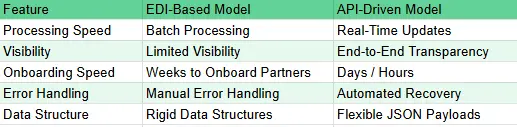
While EDI has long been a standard in logistics, its batch-based nature created bottlenecks in a world that demands immediacy.
Key Challenges PGL Faced
- Batch Processing Delays
Shipment updates like EDI 214 were processed in batches, delaying visibility—despite the fact that real-time tracking can improve on-time delivery performance by up to 30%. - Limited Visibility Across the Supply Chain
Customers couldn’t access instant updates, impacting experience and trust in an era where real-time transparency is becoming the norm. - Complex EDI Formats (204, 214, 210)
Managing X12 formats required specialized expertise, increasing operational dependency and slowing innovation. - High Maintenance Overhead
Frequent changes in partner requirements and mappings drove up costs—one of the reasons many organizations are shifting toward APIs for lower long-term integration costs. - Slow Partner Onboarding
Traditional EDI onboarding cycles took weeks, while modern API ecosystems are enabling onboarding in days or even hours. - Limited Error Handling Capabilities
Failures were difficult to track and resolve, leading to operational inefficiencies. - Dependency on Legacy Protocols
Continued reliance on AS2/SFTP restricted scalability and flexibility. - Lack of Agility
Even minor changes required significant redevelopment, hindering the ability to respond quickly to business needs.
The Solution: Transitioning to an API-First Logistics Ecosystem
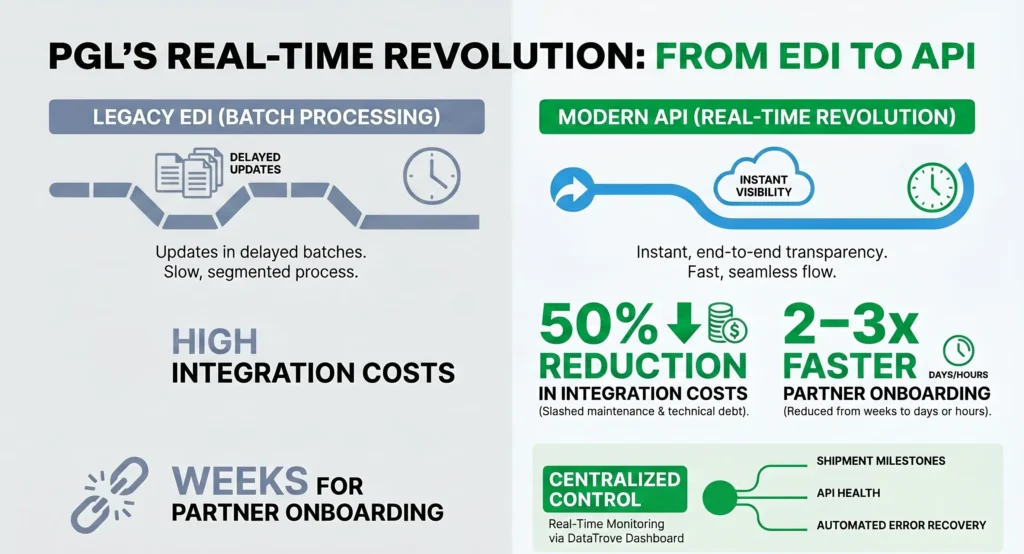
To address these challenges, PGL embraced an API-led integration strategy—designed to support real-time operations, scalability, and agility.
Core Transformation Approach
- API-Driven Communication
REST APIs exposed via API Management (APIM) enabled standardized and secure partner interactions. - Workflow Automation with Logic Apps
Automated orchestration ensured seamless data flow across systems. - Replacing EDI with Real-Time APIs
- Shipment creation via APIs (replacing EDI 204)
- Real-time milestone updates (replacing EDI 214)
- Invoice exchange using structured JSON (replacing EDI 210)
- Standardized JSON Data Exchange
Simplified payloads reduced complexity and eliminated the need for specialized EDI expertise. - Resilience & Monitoring Built-In
Retry mechanisms, logging, and centralized monitoring improved reliability and operational control. - Secure & Scalable Architecture
HTTPS-based communication with authentication ensured secure, future-ready integrations.
Transformation in Action: Before vs After
Solutions Delivered
PGL’s transformation delivered measurable business value:
- Seamless migration from EDI to APIs without disrupting operations
- Real-time shipment and milestone tracking across the ecosystem
- Faster partner onboarding aligned with modern API-driven benchmarks
- Enhanced monitoring, logging, and troubleshooting capabilities
- Gradual phase-out of legacy EDI systems
Data Trove Dashboard: From Data Overload to Actionable Insights
To complement the integration layer, we implemented the DataTrove Dashboard—a centralized control tower for logistics operations.
Key Capabilities
📍 Real-time shipment milestone tracking (pickup → delivery → exceptions)
🔍 Full visibility into API calls, workflows, and data pipelines
⚠️ Instant detection of failed transactions and integration issues
🎯 Partner-level filtering for targeted insights
🔔 Automated alerts for SLA breaches and delays
With real-time visibility becoming a top priority for logistics leaders, DataTrove enabled PGL to move from reactive firefighting to proactive decision-making.
Expertise Behind the Transformation
Integration & Middleware Expertise
- Strong experience in EDI (X12 204, 214, 210) and API transformation
- Designed API-led architecture using Azure API Management (APIM)
- Implemented Logic Apps for orchestration and automation
Data Transformation & Mapping
- Converted EDI formats into structured JSON payloads
- Developed transformation logic (XSLT / JSON mapping) for seamless data flow
- Ensured data consistency between CargoWise and external systems
Real-Time Processing
- Enabled event-driven architecture for instant updates
- Implemented real-time milestone/status tracking
Error Handling & Monitoring
- Built retry mechanisms for failed API/SFTP transactions
- Implemented logging and tracking for troubleshooting
- Improved visibility into integration flows
Scalable & Secure Architecture
- Designed scalable solutions to support multiple partners
- Implemented secure API communication (authentication, HTTPS)
- Reduced dependency on legacy protocols like AS2
Agile Delivery
- Delivered core functionalities first for quick business value
- Followed phased rollout approach
- Supported continuous improvements based on feedback
Data Trove Dashboard
- Implemented a centralized Data Trove dashboard for real-time shipment status tracking
- Provides visibility into shipment milestones — pickup, in-transit, delivered, and exceptions
- Monitors integration health, including API calls, Logic Apps workflows, and data pipeline status
- Surfaces failed transactions and integration errors for faster diagnosis and reprocessing
- Supports partner-level filtering to track specific carrier or customer integration flows
- Configurable alerts and notifications for SLA breaches and delayed milestones
Business Impact: Turning Integration into a Competitive Advantage
By moving from EDI to APIs, PGL unlocked:
- Real-time visibility across shipments and partners
- Reduced integration and operational costs
- 2–3x faster onboarding of new partners
- Improved on-time delivery performance and customer satisfaction
- Greater flexibility to adapt to changing business needs
🗣️ Customer Testimonial
“Transitioning from EDI to an API-led integration model has completely transformed how we operate. We now have real-time visibility across shipments, faster onboarding for partners, and significantly improved operational efficiency. The Data Trove dashboard gives us clarity and control we never had before.”
— Operations Head, PGL
Final Thought
As logistics continues to evolve, the gap between batch-based legacy systems and real-time digital ecosystems will only widen.
PGL’s journey shows that moving to an API-first model isn’t just about modernization—it’s about building a future-ready, scalable, and intelligent supply chain.
If your organization is looking to modernize EDI, accelerate partner onboarding, and gain real-time operational visibility, Enkaytech can help. With deep expertise in API integration, EDI modernization, and logistics technology solutions, Enkaytech enables businesses to transform complex supply chain ecosystems into agile, connected, and high-performing digital platforms.