



The AI Gold Rush Is Real… But So Are the Risks
AI adoption is exploding—and so are the consequences of getting it wrong.
- 📊 78% of enterprises are already using AI in at least one business function (McKinsey)
- ⚠️ Yet, over 60% lack formal AI enterprise governance frameworks
- 💸 And AI-related compliance violations can cost millions in fines, reputation damage, and lost trust
Here’s the uncomfortable truth:
👉 Most organizations are scaling AI faster than they can control it.
That’s why enterprise AI governance is no longer optional—it’s foundational.
What Is AI Governance (And Why It’s Not Just “Policies”)?
AI governance is the framework of policies, processes, and technologies that ensure your AI systems are:
- ✅ Transparent
- 🔐 Secure
- ⚖️ Fair & unbiased
- 📊 Accountable
- 📜 Compliant with regulations
But here’s where most companies misunderstand the AI governance business reality:
AI governance isn’t a static policy—it’s a living system embedded into your AI lifecycle.
From data ingestion → model training → deployment → monitoring → retraining, governance must be continuous and adaptive.
⚠️ The Hidden Risks CTOs Can’t Ignore
Without proper AI enterprise governance, AI becomes a liability.
- Bias & Ethical Failures
AI models trained on biased data can lead to discriminatory outcomes—especially in hiring, lending, or healthcare.
- Lack of Explainability
Black-box models create compliance and trust issues—especially in regulated industries.
- Security Vulnerabilities
AI systems are increasingly targeted via:
- Data poisoning
- Model inversion attacks
- API exploitation
- Compliance Chaos
With evolving regulations like GDPR, EU AI Act, and India’s DPDP Act, governance gaps can result in severe penalties.
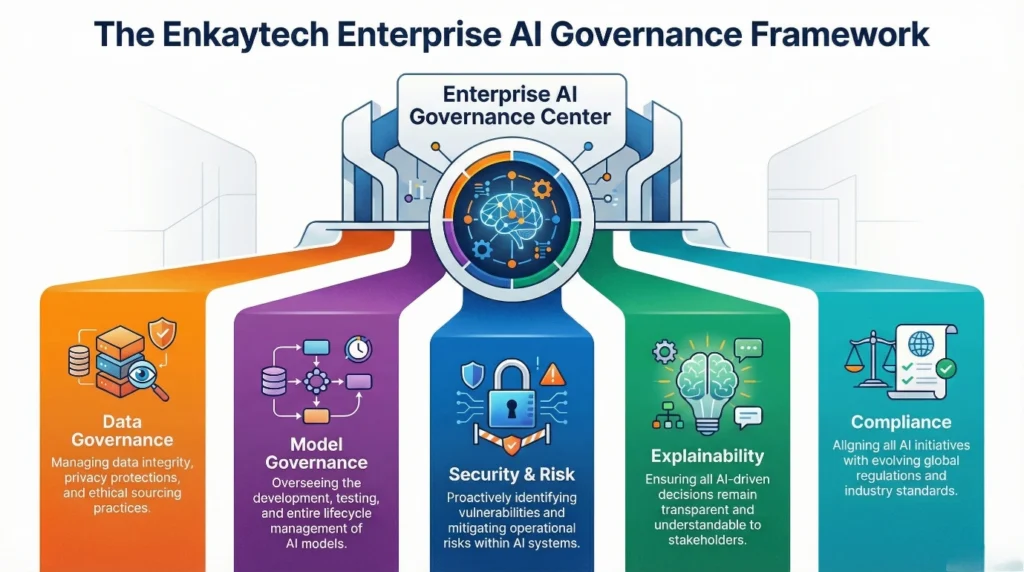
The 5 Pillars of Enterprise AI Governance
To move from AI governance business evolution → business reality, leading enterprises focus on these pillars:
- 🔍Data Governance
- Data quality, lineage, and privacy
- Role-based access control
- Regulatory compliance
- ⚙️Model Governance
- Model versioning and lifecycle tracking
- Bias detection and mitigation
- Continuous performance monitoring
- 🔐Security & Risk Management
- Secure APIs and endpoints
- Threat detection systems
- Risk scoring frameworks
- 📊Transparency & Explainability
- Explainable AI (XAI) adoption
- Decision traceability
- Audit logs
- 📜Compliance & Policy Enforcement
- Ethical AI guidelines
- Automated compliance checks
- Governance dashboards
AI Governance Tools: From Visibility to Control
To operationalize governance, organizations must invest in the right AI governance tools, such as:
- 📊 Model monitoring platforms (detect drift & anomalies)
- 🔍 Explainability tools (e.g., SHAP, LIME)
- 🔐 API governance & security gateways
- 📜 Compliance automation tools
- 📈 AI lifecycle management platforms
👉 The goal: Shift from reactive risk management to proactive AI governance.
AI models must be continuously tested and validated—leveraging Quality Assurance & Testing ensures performance, reliability, and bias detection at scale.
Real-World Use Case: Logistics AI Gone Wrong (And Fixed)
❌ The Challenge
A global logistics enterprise deployed AI to optimize shipment routing and partner selection.
But soon:
- Biased data led to unfair vendor prioritization
- No monitoring caused model drift
- APIs exposed sensitive shipment data
For similar solutions, explore Datatrove
✅ The Enkaytech Approach (AI Governance Consulting in Action)
Through AI governance consulting and integration expertise, Enkaytech:
- Implemented real-time model monitoring dashboards
- Deployed secure API governance frameworks
- Enabled audit trails for AI decision-making
- Built data validation and governance pipelines
👉 Result:
- 📉 35% reduction in AI-related errors
- 🔐 Stronger compliance posture
- 🚀 Faster and safer AI deployment
Industry Use Cases of AI Governance
🏦 Banking & Financial Services
- Transparent AI-driven credit scoring
- Fraud detection with explainability
- Regulatory compliance alignment
🛍️ Retail & E-commerce
- Ethical recommendation engines
- Customer data protection
- Bias-free pricing algorithms
🏥 Healthcare
- Governed clinical AI systems
- Patient data privacy compliance
- Explainable diagnostics
🚚 Logistics & Supply Chain
- Fair vendor selection models
- Predictive demand planning
- Secure partner integrations
🧩 How CTOs & AI Leaders Should Start
A practical roadmap to move from AI governance business evolution → execution:
Step 1: Assess AI Risk & Maturity
Identify gaps in governance, compliance, and monitoring
Step 2: Define Enterprise AI Governance Framework
Align policies with business and regulatory goals
Step 3: Implement AI Governance Tools
Adopt platforms for monitoring, explainability, and compliance
Step 4: Integrate Governance into DevOps
Embed governance into CI/CD and MLOps pipelines
Step 5: Continuous Monitoring & Optimization
AI evolves—your governance must too
🚀 The Future: AI Governance = Business Survival
The shift from AI governance business evolution to AI governance business reality is already happening.
By 2030:
- AI governance will be as critical as cybersecurity
- Real-time AI audits will be mandatory
- Trustworthy AI will become a brand differentiator
Final Thought
As AI scales across the enterprise, governance isn’t just about risk—it’s also about cost control.
💡 Coming soon: A deep dive into FinOps for AI and how it helps enterprises optimize AI spend while maintaining governance and performance.
Looking for expert AI governance consulting to scale AI securely and responsibly?
👉 Partner with Enkaytech to implement end-to-end AI enterprise governance—from strategy to execution.
 PREVIOUS POST