

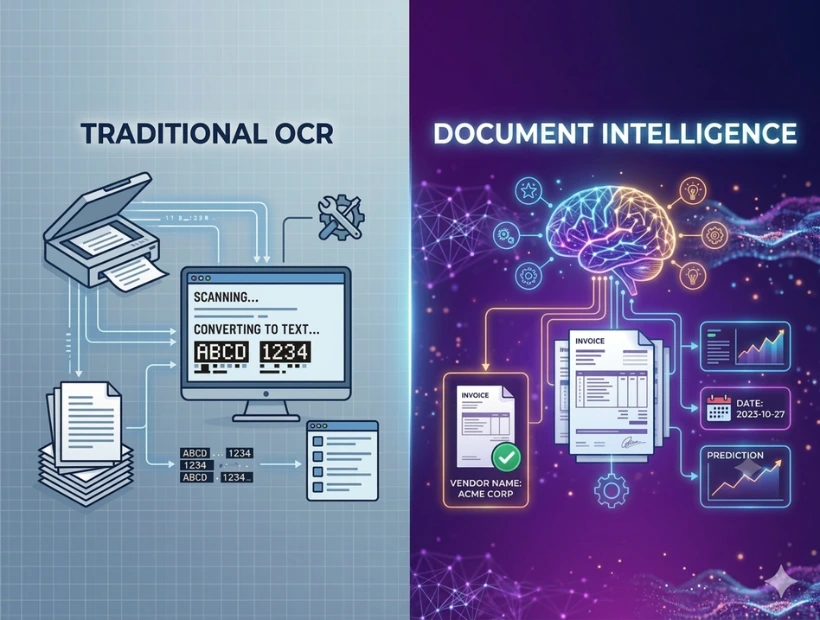

Every enterprise today is flooded with documents.
Invoices. Purchase Orders. Bills of Lading. Proof of Delivery (POD). Insurance Claims. KYC Forms. Vendor Contracts. Emails. PDFs. Scanned handwritten documents.
And while businesses have spent years digitizing paperwork using OCR (Optical Character Recognition), many are now discovering a harsh reality:
OCR alone is no longer enough.
In an era driven by AI, automation, and real-time business operations, companies need systems that don’t just read documents — they need systems that can understand, classify, validate, and act on them intelligently.
That’s where Document Intelligence (IDA) comes in.
From logistics and supply chain to finance, healthcare, insurance, and manufacturing, Intelligent Document Processing is rapidly becoming one of the biggest digital transformation trends of 2026.
So what’s the actual difference between Traditional OCR and Document Intelligence?
And more importantly — which one creates real business value?
Let’s break it down.
What is Traditional OCR?
Traditional OCR (Optical Character Recognition) is a technology that converts printed or handwritten text from scanned documents or images into machine-readable text.
For years, OCR has helped businesses:
- Digitize paper documents
- Reduce manual data entry
- Extract text from PDFs
- Archive physical records
- Search document content digitally
For example:
- Converting invoices into editable text
- Reading shipping labels
- Extracting customer information from forms
- Digitizing historical records
OCR was revolutionary when businesses first began their digital transformation journeys.
But modern enterprise workflows have become far more complex.
Today’s documents are:
- Unstructured
- Multi-format
- Handwritten
- Low quality
- Context-heavy
- Spread across multiple systems
And that’s where traditional OCR starts to struggle.
The Biggest Problem with Traditional OCR
Traditional OCR can read text.
But it cannot truly understand the document.
For example:
- It may extract “Invoice Number”
- But fail to identify whether it belongs to the supplier, customer, or shipment
- It cannot validate business rules
- It cannot detect anomalies
- It cannot classify document types accurately
- It cannot trigger intelligent workflows automatically
This creates several operational challenges:
- High Manual Validation Effort
Teams still spend hours reviewing extracted data for accuracy.
- Poor Handling of Unstructured Documents
Emails, handwritten forms, contracts, and mixed-layout PDFs confuse traditional OCR engines.
- Limited Context Awareness
OCR reads text line-by-line without understanding relationships between data points.
- Frequent Errors
Low-quality scans, rotated documents, stamps, signatures, and varying templates often reduce extraction accuracy.
- No Business Intelligence
OCR does not make decisions or automate workflows.
It simply extracts text.
What is Document Intelligence?
Document Intelligence combines:
- Artificial Intelligence (AI)
- Machine Learning (ML)
- Natural Language Processing (NLP)
- Computer Vision
- Workflow Automation
- Generative AI
- Business Rules Engines
to create systems that can:
✔ Understand documents
✔ Extract contextual information
✔ Validate data intelligently
✔ Learn from corrections
✔ Trigger downstream business processes automatically
Instead of just digitizing text, IDA transforms documents into actionable business intelligence.
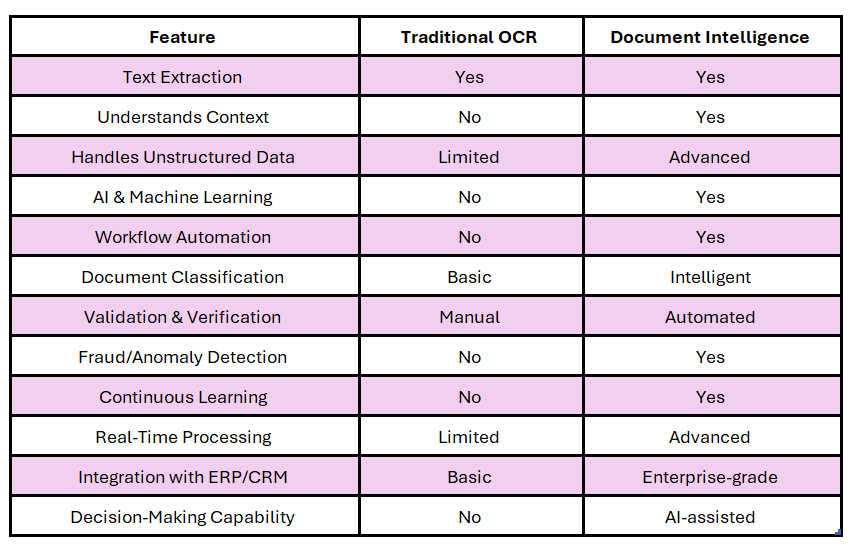
Traditional OCR vs Document Intelligence
Why Document Intelligence is Trending in 2026
The rise of Intelligent Document Processing is being fuelled by several major technology and business trends:
- Generative AI Adoption
Businesses are rapidly integrating AI copilots and LLMs into operations.
Modern IDA platforms can now:
- Summarize documents
- Extract insights
- Detect intent
- Generate responses
- Route workflows intelligently
- Hyperautomation Initiatives
Organizations are moving beyond simple automation toward end-to-end intelligent workflows.
Document automation is becoming a core component of:
- Finance automation
- Supply chain automation
- Customer onboarding
- Claims processing
- Vendor management
- Explosion of Unstructured Data
Industry reports suggest that nearly 80–90% of enterprise data is unstructured.
Traditional OCR simply cannot manage this scale effectively.
- Real-Time Business Expectations
Modern supply chains and operations demand:
- Faster approvals
- Instant document processing
- Real-time visibility
- Reduced operational delays
- Compliance & Audit Requirements
Industries like BFSI, healthcare, and logistics require:
- Accurate documentation
- Audit trails
- Secure processing
- Automated compliance validation
Document Intelligence helps businesses meet these requirements efficiently.
Real-World Use Cases of Intelligent Document Automation
Logistics & Supply Chain
- Proof of Delivery (POD) automation
- Bill of Lading extraction
- Freight invoice processing
- Shipment document validation
- Customs documentation workflows
Finance & Accounting
- Accounts payable automation
- Invoice processing
- Expense claim verification
- Tax document extraction
- Financial reconciliation
Insurance
- Claims document automation
- KYC processing
- Fraud detection
- Policy document validation
Healthcare
- Patient form digitization
- Medical records extraction
- Insurance authorization workflows
Manufacturing
- Vendor onboarding
- Quality inspection reports
- Procurement documentation
The Business Benefits of Document Intelligence
Organizations adopting IDA are seeing measurable improvements across operations.
Faster Processing Times
Reduce document handling time from hours to minutes.
Lower Operational Costs
Minimize manual intervention and repetitive data entry tasks.
Improved Accuracy
AI-driven validation significantly reduces human errors.
Better Customer Experience
Faster response times improve customer satisfaction and service delivery.
Scalability
Process thousands of documents without increasing workforce dependency.
Enhanced Decision-Making
Convert document data into actionable insights and analytics.
OCR Alone is No Longer a Competitive Advantage
Many businesses still rely on legacy OCR systems thinking they are “automated.”
But automation without intelligence creates bottlenecks.
In today’s AI-driven enterprise landscape, organizations need:
- Intelligent workflows
- Context-aware systems
- Real-time integrations
- AI-powered decision-making
- End-to-end automation visibility
That’s the difference between digitization and true digital transformation.
How Enkaytech Helps Businesses Modernize Document Processing
At Enkaytech, we help enterprises move beyond traditional OCR by building intelligent, scalable, AI-powered document intelligence solutions tailored to business operations.
Our Document Intelligence solutions combine:
- AI & Machine Learning
- Azure AI Services
- Document Intelligence
- Intelligent Workflows
- API Integrations
- ERP/CRM Connectivity
- Business Process Automation
- Data Validation Engines
- Real-Time Monitoring
We help businesses automate:
- Invoice processing
- Logistics documentation
- POD workflows
- KYC and onboarding
- Financial approvals
- Vendor management
- Compliance documentation
Why Businesses Choose Enkaytech
Enterprise Integration Expertise
We integrate document automation directly into existing business ecosystems including:
- SAP
- Microsoft Dynamics 365
- Oracle
- Salesforce
- Warehouse Management Systems
- Logistics Platforms
AI-Driven Automation Approach
We leverage modern AI technologies to improve:
- Accuracy
- Speed
- Decision-making
- Operational visibility
Scalable Cloud Architecture
Our solutions are designed for:
- High-volume document processing
- Multi-format ingestion
- Enterprise-grade security
- Future scalability
End-to-End Business Process Transformation
We don’t just automate documents.
We automate entire workflows.
Final Thoughts
Traditional OCR helped businesses enter the digital era.
But Document Intelligence is helping businesses compete in the AI era.
The future of enterprise operations is no longer about simply reading documents — it’s about understanding them, acting on them, and transforming them into business intelligence automatically.
Organizations that continue relying solely on legacy OCR systems risk:
- Operational inefficiencies
- Slow decision-making
- Higher manual costs
- Poor scalability
- Limited automation maturity
Businesses that embrace Document Intelligence will gain:
- Faster operations
- Smarter workflows
- Better customer experiences
- Stronger compliance
- Competitive advantage
The question is no longer:
“Should we digitize documents?”
The real question is:
“How intelligently can your business process them?”
Looking to Modernize Your Document Workflows?
Enkaytech helps businesses build Document Intelligence solutions that improve operational efficiency, accelerate workflows, and enable AI-driven business transformation.
Connect with Enkaytech to explore how Document Intelligence can streamline your enterprise operations.
 PREVIOUS POST